New rating valuations finalised for Marlborough

Marlborough property owners will soon receive new three-yearly rating valuations in the post.
Updated values have been prepared for all 28,145 properties in the district by independent valuers Quotable Value (QV) on behalf of Marlborough District Council. They reflect the likely price a property would have sold for on 1 July 2026, not including chattels.
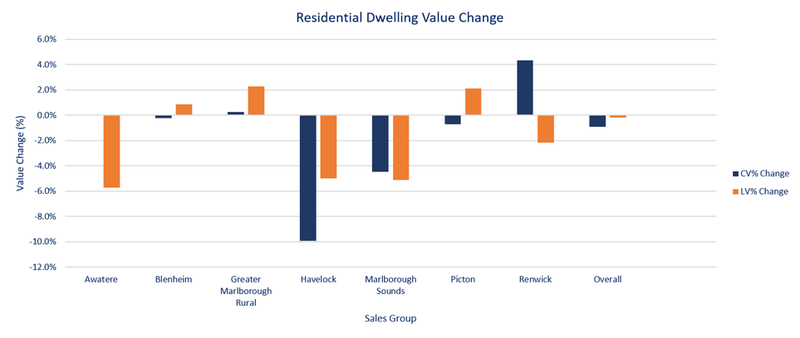
Since the district’s last revaluation in 2023, the value of residential housing has decreased by an average of 0.8%. The average house value is now $717,000, while the corresponding average land value has also decreased by 0.2% to $367,000.
QV Nelson/Marlborough Manager Craig Russell said it had been a difficult property market over the past three years, with rising interest rates and stagnant population growth.
“Overall, the residential market is relatively stable, with most properties showing modest movement relative to the 2023 valuations – although this varies by locality and property type,” he said.
“The residential property market has remained subdued in 2026, with conditions favouring buyers. First-home buyers remain the most active purchasers, with regional sales activity concentrated below $800,000, while investors remain cautious.”
“There is also less activity than usual in the Marlborough Sounds, particularly in the outer Sounds, reflecting the wider economic climate both locally and nationally.”
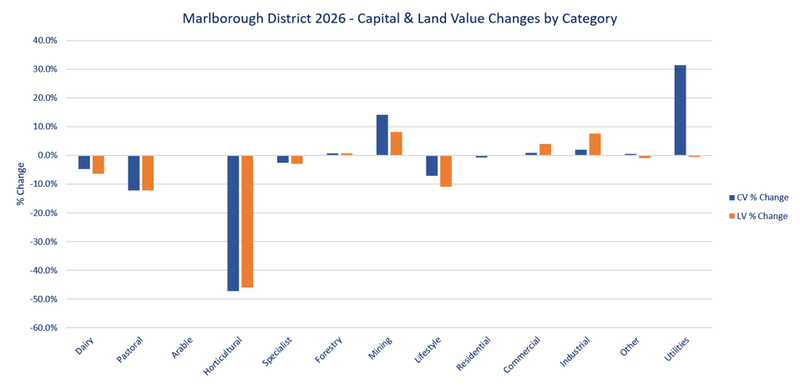
The average capital value of an improved lifestyle property has decreased by 6.7% to $1,126,000, while the corresponding land value decreased by 11.6% to $561,000.
“Marlborough’s lifestyle market has softened since the 2023 revaluation, primarily due to broader economic weakness and the ongoing downturn in the viticulture sector,” Mr Russell said.
“The greatest value reductions have occurred in larger lifestyle properties containing established vineyards or land with viticultural potential. By comparison, lifestyle properties in the Marlborough Sounds have shown greater resilience.
“The slowdown in the viticulture market has also had an impact on the higher end of the lifestyle market, with properties approaching the $2 million mark experiencing slower demand,” he said.
While residential values have remained relatively stable overall, there have been much larger movements in some other property sectors across the district.
Mr Russell said the viticulture market had been in a state of decline due to a worldwide oversupply of grapes and changing consumer drinking habits, significantly impacting values.
“Marlborough’s rural property market has been uneven, with vineyard values under downward pressure from reduced grape returns, weaker buyer demand, and continuing uncertainty in the wine industry.
“The majority of viticulture growers within the district have been subject to strict yield caps for the 2025/26 season, while other growers have had their Grape Supply Agreements reviewed or cancelled. This has left some vineyards facing high production costs with no destination for their grapes.”
The average capital value of a horticultural block has decreased by 47.3%, while the corresponding land value decreased by 46%, representing a reduction of approximately $3 billion.
“For context, Marlborough was last revalued in 2023, near the peak of the viticulture market, when land values had increased by approximately 90% since the 2020 revaluation.”
Meanwhile, the commercial property market remains generally subdued but stable. Commercial values have increased by 0.8% and property values in the industrial sector have increased by 1.9% since the district’s last rating valuation in 2023.
Commercial and industrial land values have also increased by 3.9% and 7.6% respectively.
The total rateable value for the district is now $29.13 billion, with the land value of those properties now valued at $15.89 billion.
Residential Dwellings 2026 Average Values
Capital & Land Value Changes by Category:
What are rating valuations?
Rating valuations are usually carried out on all New Zealand properties every three years to help local councils set rates for the following three-year period. They are not intended to be used for any other purpose, including raising finance with banks or as insurance valuations.
They reflect the likely selling price of a property at the effective revaluation date, which was 1 July 2026, and do not include chattels. Any changes in the market since that time will not be included in the new rating valuations, which often means that a sale price achieved today will be different to the new rating valuation.
Rating valuations are calculated using a complex process that utilises all relevant property sales from an area. A large number of properties are also physically assessed, particularly those that have been issued building consents in the last three years.
The revaluation does not increase or decrease the total amount of rates the council needs to collect. Instead, it can change how rates are distributed between different properties and sectors. If the value of a property has increased by more than the average in a district, which is minus 17% for Marlborough, it will attract a larger share of rates. If a property value fell by more than the average, it will likely attract a lesser share of the total rates.
The updated rating valuations are independently audited by the Office of the Valuer-General to ensure they meet rigorous quality standards before they are confirmed and posted to property owners.
If owners do not agree with their rating valuation, they have a right to object through the objection process before 11 December 2026.
For further information and to lodge an objection go to https://www.marlborough.govt.nz/services/rates/rateable-valuations